Unscramble
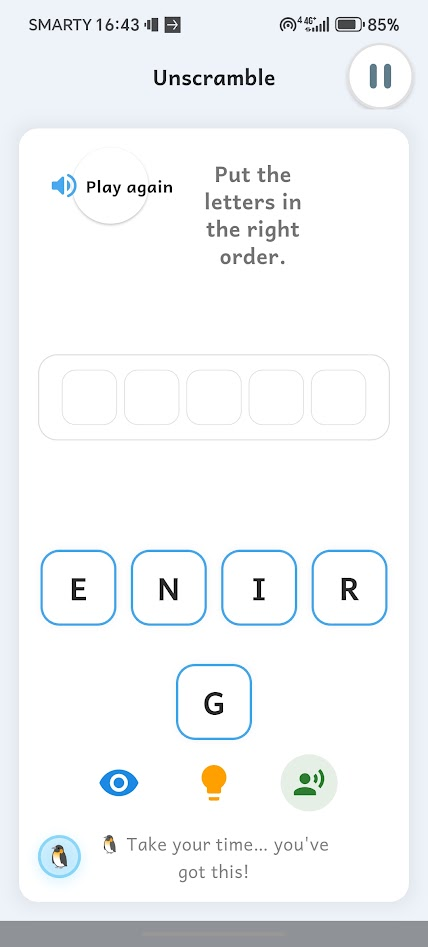
Put the letters in the right order.
Well done!
Try Our Free Online Spelling Game
Unscramble: Listen, Think and Build the Word
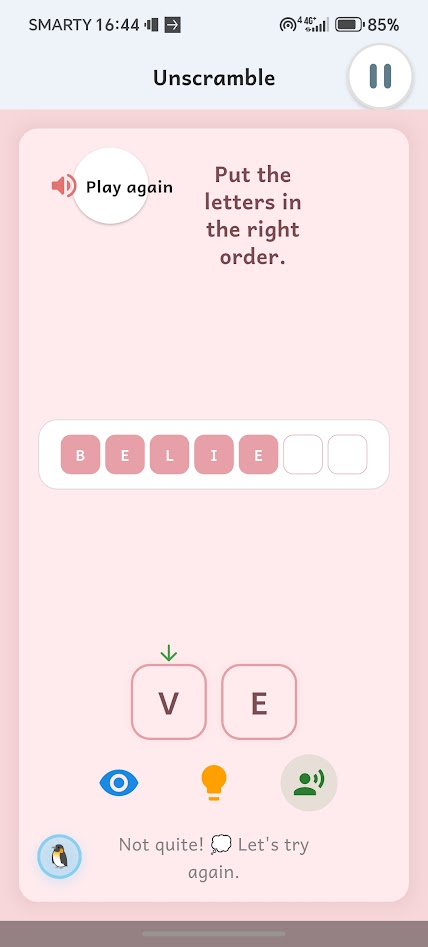
Give your child a chance to try Spell Step’s interactive Unscramble spelling game directly on this page. Children hear a word and then arrange the mixed-up letters in the correct order. They can listen again or use a hint when they need help.
How to play:
- Choose the appropriate age group at the top of the screen.
- Press “Hear the word” and listen carefully.
- Select the letters in the correct order.
- Use a hint if you get stuck.
- Complete the word and celebrate your success.
The taster game provides up to 30 words in a session. It is a practical introduction to the type of spelling activity available in the full Spell Step app.
Ready for more? Moving beyond this taster gives children access to a complete daily spelling routine.
? Download Spell Step from Google Play or explore our 2026 learning features.
Looking for fun spelling games for kids aged 4–11? Spell Step makes spelling practice interactive, with activities that encourage children to listen to words, recognise letters, build spellings and practise putting letters in the correct order.
Whether your child is just starting to learn their first words or developing more advanced primary-school spelling skills, engaging activities can make regular practice feel more enjoyable. Try our free interactive spelling game and see how Spell Step works.
Why Use Spelling Games to Help Children Learn?
Spelling is an important part of reading and writing. Children need opportunities to recognise letter patterns, connect sounds with words and remember how words are written. Spelling games provide another way to practise these skills alongside reading, writing and schoolwork.
- Make spelling practice interactive: Instead of only copying words from a list, children can listen, select letters, build words and check their answers as they play.
- Practise a little at a time: Short, manageable activities can make spelling practice easier to fit into a family routine. Regular practice gives children more opportunities to revisit words and develop confidence.
- Encourage children to work things out: Activities that ask children to recall a spelling or arrange letters give them an opportunity to think through a word rather than simply look at the answer.
- Provide encouragement when children need help: Hints, clear instructions and positive feedback can help children approach difficult words without feeling that every mistake is a failure.
Discover Spell Step’s Broader Spelling Activities
The free Unscramble game is an introduction to Spell Step. Learn more about our structured approach on our Let’s Play Spelling program overview. The full app provides a comprehensive learning experience taking children through a sequence of varied activities:
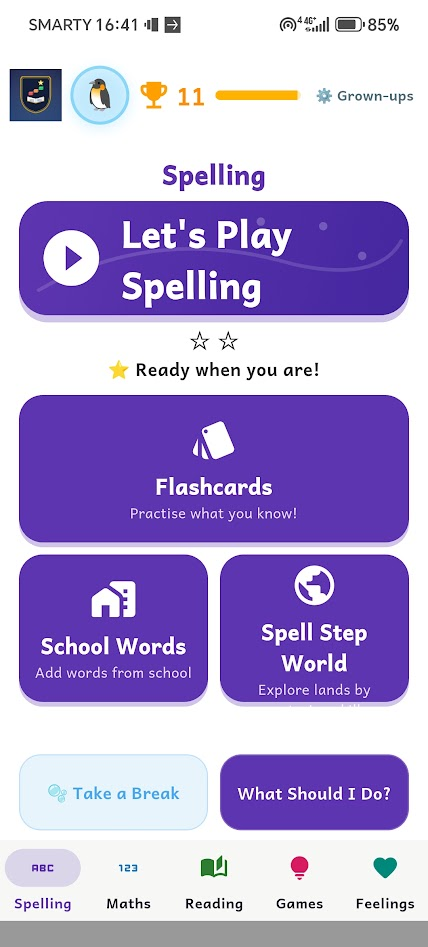
The program guides children through 2 new words each day using multiple interactive steps:
Spelling Games for Reception, KS1 and KS2
Children develop spelling skills as they progress through primary school. Activities should suit their current ability, with opportunities to revisit familiar words and tackle new challenges across key developmental stages:
- Reception (Ages 4–5): Young learners are beginning to connect sounds and letters. Simple words, listening activities and opportunities to recognise letters help introduce early spelling practice.
- Key Stage 1 (Years 1 and 2): Children develop their knowledge of common words and spelling patterns. Activities help them practise letter order, recognise familiar spellings and become more confident when writing.
- Key Stage 2 (Years 3–6): Older primary-school children encounter a wider range of vocabulary, less predictable spelling patterns and more challenging words. Continued practice reinforces the spellings they meet in school.
Frequently Asked Questions
What are the best spelling games for kids?
The best spelling games are appropriate for a child’s current ability and give them opportunities to practise spelling actively. Listening games, letter-building activities, missing-letter exercises and word-unscrambling games can all provide useful practice.
Are there free online spelling games for children?
Yes. Children can try the free interactive Unscramble spelling taster on this page. It lets them hear words and arrange letters in the correct order without needing to start by downloading the full app.
What age is Spell Step suitable for?
The spelling taster and app are designed for children aged 4–11, covering Reception through Year 6 age groups.
How can I help my child improve their spelling?
Encourage regular, manageable practice. Read together, talk about unfamiliar words, practise school spelling lists and revisit difficult spellings. Interactive games can provide an additional way to work with words.
Can spelling games help children who find spelling difficult?
They can offer an alternative way to practise, especially when activities provide clear instructions, repetition and appropriate support. Children have different needs, so choose activities that suit your child and use them alongside other learning support.
Should children use spelling games instead of reading and writing?
No. Spelling games are best used alongside reading, handwriting, writing activities and the spelling guidance children receive at school. A variety of activities gives children opportunities to apply their skills in different contexts.
Try Spell Step
Ready to explore more spelling activities? Try the interactive Unscramble game on this page, then discover the full app for additional daily practice.
Why Anagrams Are Good for the Brain and Learning
Engaging with anagrams and word-scramble puzzles activates complex networks across the brain, supporting executive function, working memory, and lexical retrieval.
1. The Generation Effect and Enhanced Memory Encoding
Active cognitive problem-solving—such as unscrambling letters to discover a hidden word—activates neural pathways more intensely than passive reading or rote memorization.
This phenomenon, known in cognitive psychology as the generation effect, demonstrates that solutions produced through active mental operations are remembered and retained significantly better (Foley & Foley, 2007).
2. Cognitive Flexibility and Overcoming Mental Heuristics
Solving anagrams requires individuals to mentally manipulate letter positions, test hypotheses, and break through habitual visual scanning patterns.
Eye-tracking and problem-solving studies show that when tackling anagrams, people must overcome preconceived linguistic heuristics (such as stereotypical bigram combinations) to find unconventional solutions, which directly exercises cognitive flexibility and executive control (Murray et al., 2022).
3. Lexical Retrieval and Language Processing
The brain relies on semantic priming, lexical mapping, and statistical knowledge of language (recognizing valid letter groupings or n-grams) to rapidly evaluate potential letter combinations.
Regular exposure to word puzzles keeps these orthographic and semantic pathways agile, facilitating quicker word access and language processing.
Try Spell Step
Ready to explore more spelling activities? Discover the full app for additional daily practice or visit one of our other pages :
? Download Spell Step on Google Play
? Return to the Spell Step Homepage
? Try the Year 4 Times Table Practice Game
? Play Unscrambled
? Download Free spelling sheets
? Try Spelling app for Kids
? Really Popular Look, Cover, Write, Check Worksheets
? Create Custom Spelling Worksheets
? Print Spelling Worksheets
? The Year 4 Multiplication Practise pp
? Read more about our curriculum in Let’s Play Spelling